My 8-bit Journey
Looking at the 8-bit computers I have owned and/or programmed on

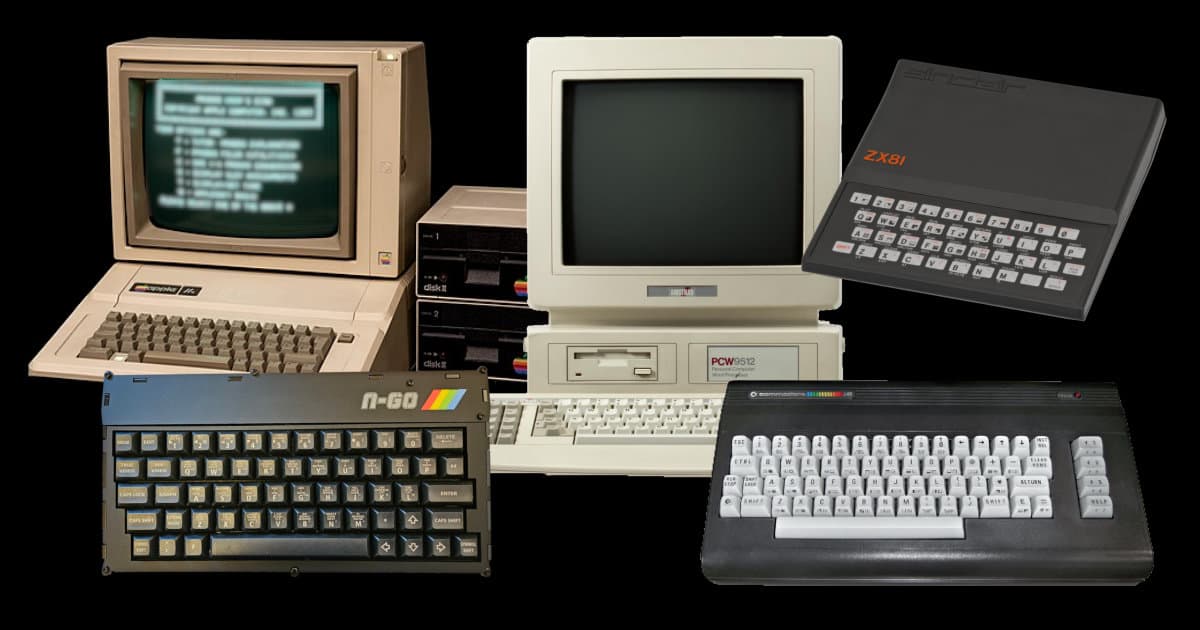
This post traces my journey from the ZX81 to the Spectrum Next, exploring how those machines shaped my career and current projects.
Pre 8-bit
Before owning my first 8-bit computer I'd had no experience with computers or programming at all. None of the subjects I was studying for O-level included any exposure to computers. I remember that there was some sort of terminal access to a computer available in the school as my best friend at the time showed it to me during one lunch break. I don't recall what you had to be studying to get access to it.
I must have been well aware of developments in computing though and the appearance of new home machines as I was an avid viewer of Tomorrow's World. But the exciting personal gadgets of the time (mid to late 1970s) were electronic calculators and digital watches.
ZX81 (1982)
I bought my ZX81 some time in 1982 from my local WH Smith store in the Gracechurch Centre, Sutton Coldfield. I can't recall exactly when. I know that I was incredibly excited at the time and remember several visits to the store to look at their display and to try it out for myself. I don't think I needed much convincing and bought one using my own money (I would have been 16 or 17 and had some savings from working on Thursday and Friday evenings in Waitrose).
What is an 8-bit computer?
An 8-bit computer refers to machines where the CPU processes data in 8-bit chunks (one byte at a time). Think of it like a person who can only carry 8 small boxes at once: each box is a bit (a 0 or 1), and the armful of 8 boxes is one byte. With 8 bits, you can represent 2^8 = 256 different values, which gives you the range 0 to 255 when working with unsigned (positive-only) numbers. If you need to represent negative numbers as well, one bit is used for the sign, reducing the range to -128 to +127. This means the processor can work with these ranges in a single operation. If it needs to handle a bigger number - say a score of 10,000 - it has to split that into multiple 8-bit pieces and handle them in several steps, like making multiple trips with 8 boxes each instead of one trip with more boxes. Most 8-bit computers from the 1980s, including the ZX81, Commodore 16, and Apple IIe, used processors like the Z80 or 6502 family that had 8-bit data buses but 16-bit address buses. The data bus is like the boxes being carried, while the address bus is like a filing system that determines which storage location (memory address) the CPU can reach - with 16 bits for addressing, it can access 2^16 = 65,536 different memory locations, giving the familiar 64 KB limit. Systems with more than 64 KB of RAM, such as the Amstrad PCW 9512 with 512 KB or the ZX Spectrum 128, used bank switching to overcome this limitation by swapping different blocks of memory in and out of the addressable space. The "8-bit era" of home computers typically refers to machines from roughly 1977 to the early 1990s, when they were gradually superseded by 16-bit systems like the Amiga and Atari ST for home use, while the PC world had largely moved to 32-bit x86 processors by the early 1990s.
The ZX81 was based on the Zilog Z80-compatible NEC D780C-1 CPU running at 3.25 MHz, with 1 KB of onboard RAM and 8 KB of ROM containing the Sinclair BASIC interpreter and operating system. Video output was a black and white 32×24 text display over RF to a domestic television.
I immediately got stuck into learning BASIC, using the supplied ZX81 BASIC Programming manual and the ZX81 edition of the National Extension College book 30 Hour BASIC by Clive Prigmore. My trusted Hitachi TRG-295 cassette recorder was used to save and load programs and I soon upgraded to the wobbly 16K RAM pack secured with Blu Tac (I had the ZX-PANDA version by Stonechip Electronics). The membrane keyboard soon started splitting from all the use it was getting and I bought one of those stick-on keyboards with raised keys. I was lucky to have a small black and white portable TV in my bedroom to hook the ZX81 up to. My dad and I had bought it from an electrical store in Swansea in 1976 when we were staying in a caravan on the Gower so that we could watch the Montreal Olympics. That little TV accompanied me to University and many bed-sits beyond.
Programming was always my main use of the ZX81 and I do not recall buying many games. The only commercial software I remember is Flight Simulation by Psion Software. I spent many many hours playing that.
I have one surviving listing of one of my own programs, printed using the ZX Printer and dated 1984. This was called Money Manager and had the following features:
-
Open new accounts with a named account and opening balance
-
Enter credits/debits with dates, payment methods (cash/cheque), and values
-
Track cheques separately with cheque number, payee, and amount
-
Display statements with running balance calculations
-
Print to printer
-
Save/load data to cassette tape
-
Memory management - checks available RAM before adding transactions
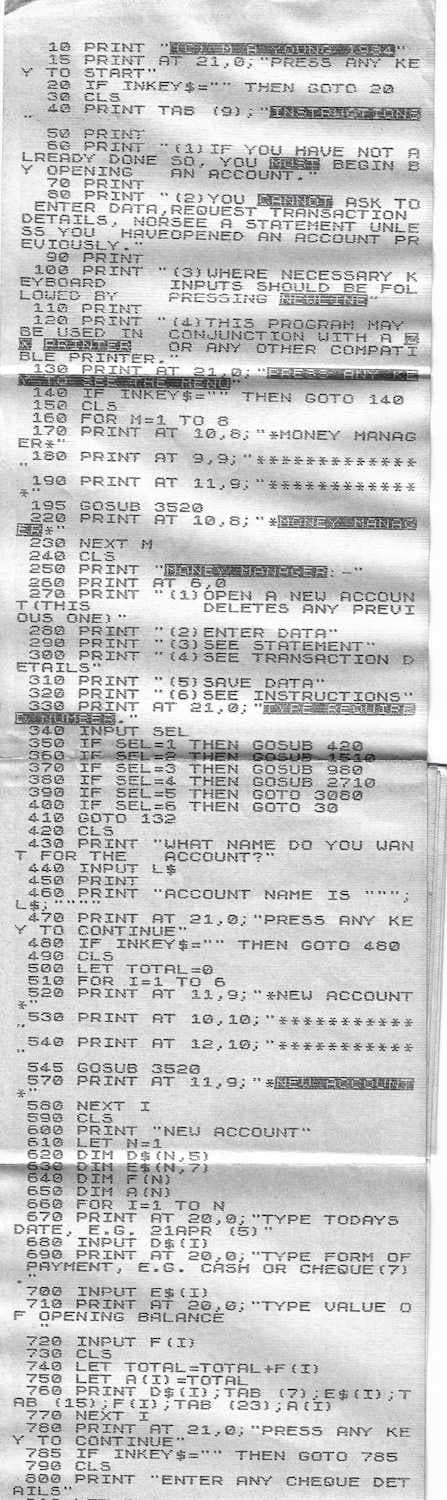
Money Manager programme listing (part)
I'll write a separate blog post about Money Manager, but it was probably the most substantial program I wrote on the ZX81. I submitted it to one of the magazines. Perhaps unsurprisingly, I never heard anything back!
University Years (1983-86)
In September 1983 I headed off to Aberystwyth to study Botany (later switching to Aquatic Biology). One of my University friends was studying Computer Science which I was always slightly envious of. But natural history was another passion of mine and I never even considered Computer Science as an option. I'm guessing A-level maths was probably a requirement and I'd chosen to do A-levels in Biology, Chemistry and Economics.
I'm not sure if my ZX81 went with me or not. I certainly don't remember ever using it there. However, I do have a diary entry from 23 January 1985 noting my frustration that I was unable to get The Fast One to load when visiting a friend who lived some distance from campus. I can only assume that this refers to the database program for the ZX81 by Campbell Systems, so I must have had the ZX81 with me.
My course did include computing modules, which involved programming in BASIC and FORTRAN. From my now rather sketchy memory, I believe that there was a terminal that allowed interactive programming in BASIC, but the FORTRAN code had to be submitted on paper coding sheets. Operators then created punch cards which we then had to submit for batch processing on the mainframe (typically getting the output a day or so later). Any error in the code meant repeating the entire procedure again.
I had access to Colossal Cave Adventure - a text-based adventure game - via the University mainframe terminals and I spent many an evening in the computer room playing that. We also had access to a Sirius 1 micro-computer (a 16-bit computer). A diary entry from January 1985 notes:
I bought myself a floppy disc today for the Sirius micro-computer. Messed around with the WordStar word processing disc. It's great - can write letters etc. It's a bit complicated though.
I must have become proficient as I ended up writing up my dissertation using it as well as many letters to family. Here are some extracts from a letter to my parents in February 1985, where I mention using WordStar and an upcoming computer science project:
I am using the WordStar word processor at the moment.
Today the computer science lecturer set a project which has got to be handed in by 8/3/85 and it is part of the course assessment - so I'll have to spend what little time I get sorting that out.
I am enclosing some examples of the graphics capabilities of the Sirius Microcomputer which Dad might be interested in. The project that we've got to do is in BASIC by-the-way so it isn't going to cause much of a problem because I know all about that whilst many of the others don't know what's going on.
At the time I regularly bought several of the Sinclair-focussed computer magazines. One of the less well known ones (compared to Crash, Your Sinclair, and Sinclair User) was ZX Computing. There were issues with the accuracy of the program listings in magazines at that time, although ZX Computing seems to have had a particularly bad reputation (see this article by Simon Goodwin on his experiences writing for the early home computing magazines). I clearly found this very frustrating, as this comment in the same letter to my parents confirms:
Dad will be interested to know that I got a free computer magazine (ZX Computing) because I wrote a letter complaining about all the mistakes in the magazine whenever I buy it. So I got this months free which is worth £1.95!!!
Commodore 16 (1985)
In March 1985 it looks like I finally reached the limits of the ZX-81 (or just couldn't cope with the frustrations of the keyboard any longer) and made the decision to upgrade. As a student, money was limited, but a special offer for the Commodore 16 (released mid 1984) proved irresistible. On Saturday 23 March 1985 I wrote in my diary:
Didn't wake up 'till 2.25!!! Got up and went down town [and] browsed around the shops. The Commodore 16 Starter Kit - at £69 - looks a very good buy indeed - I'm getting quite interested in it - I haven't got any money at the moment though.
In a scary behaviour trait that seems to have stayed with me whenever there is a gadget that I really take a liking to; just two days later on Monday 25 March I wrote:
Went down town this afternoon. Withdrew £70 from Building Society and bought Commodore 16 Computer (half the price it was at Xmas). As you can imagine I spent much of rest of day experimenting with it. The BASIC is very modern indeed - very similar to BASIC 86 on the SIRIUS. In evening borrowed Ian's tele (colour) to see if it was O.K. Played Punchy and one of the arcade type games. Ian and Alex came in later and had a mess around with the games and Rolf Harris Picture Builder. Didn't get to sleep 'till quite late!!
The Commodore 16 was an 8-bit computer featuring a MOS 7501/8501 CPU that was part of the 6502 family. It represented a significant upgrade from my ZX81 despite both machines having 16 KB of RAM when the ZX81 was expanded. It had a proper full-travel keyboard instead of the ZX81's notorious membrane keyboard, substantially better graphics capabilities with a TED (Text Editing Device) chip which provided graphics output of 320×200 pixels with 121 colours versus the ZX81's monochrome 32×24 text display, integrated sound generation, and a more advanced BASIC 3.5 interpreter. The machine also benefited from 75% faster processor performance compared to earlier Commodore machines such as the Commodore 64 and VIC-20. And of course, the Commodore 16's RAM was built-in and reliable, unlike the ZX81's 16K expansion that was notoriously unstable and prone to crashes if knocked.
I don't remember much of what I used the Commodore 16 for, but some diary entries from April 1985 shed some light:
Went to Sutton this afternoon. Had my hair cut at Peter's. Wandered around shops and bought 2 cassettes. Also looked at some of the CBM (Commodore) 16 software available - there's quite a bit coming in now including a flight simulator programme.
I do know that I was keen on text-based adventure games at that time, no doubt due to discovering Colossal Cave Adventure on the mainframe. Though from these August 1985 diary entries it appears that I didn't find them challenging enough (especially after the legendary complexity of Colossal Cave):
In p.m. for some reason had sudden urge to purchase Pirate Adventure (a cartridge) for my computer so went to Brum. Spent quite a bit of evening playing the adventure. Appeared very good.
Unfortunately today [the next day!] I solved the adventure - I must be too clever - I thought, god was it worth £11.95 for only 1 days usage. Decided to send it to Commodore pretending I'd had it as a present and already had it and asking them to exchange it for Atomic Mission - another adventure - I don't know whether they will or not but I hope so!!
Start of career
After several temporary jobs, including working in hotels, I got my first "proper" job at the beginning of 1990, as a Biology Technician for Anglian Water Services, based in the Cambridge Laboratory (now long gone).
Apple IIe (1990)
As part of my job, along with other colleagues, I was required to carry out algal counts of samples from Anglian Water's storage reservoirs (such as Rutland Water and Grafham Water). This involved using an inverted microscope to carry out a set number of random counts of the water sample on a specialised microscope slide. From what I recall, this meant setting the magnification, randomly selecting a field of view, and then within that view identifying each species along with a count. This was then repeated a set number of times. At the end of the process a calculation was performed to convert these counts into cells per ml. The final part of the process was completing forms that were submitted to be inputted into a central water quality monitoring database. This was an entirely manual process, recording the counts, performing the calculation, and completing the necessary forms by hand.
At this time we did not have any desktop computers within our section. IBM PC clones were just starting to be introduced in the drinking water analysis section of the laboratory. However, I did spot an old computer stacked away on a shelf. This turned out to be an Apple IIe with dual floppy disk drives and a monitor. The Apple IIe was an 8-bit computer based on a 6502-family CPU running at around 1 MHz and it was launched in the UK in 1983. It typically came with 64 KB of RAM and used 5.25-inch floppy disk drives for storage.
I borrowed the Apple IIe and took it back to my bedroom in a shared Victorian terraced house on Homerton Street (demolished some decades ago) and then spent several weeks in my spare time after work writing a program in Applesoft BASIC to automate all the manual processes (apart from the identification and counting itself of course). I don't think I even told my colleagues what I was doing!
Some time later I presented the program to one of my colleagues. With a bit of a smirk he started bashing away on the keyboard, randomly entering values and pressing keys. He was convinced that he was going to be able to crash the program in no time at all. He failed. I'd done a really thorough job, with lots of error checking and validation. And I was chuffed!
For a scientific data collection program where losing counts after an hour of microscope work would be crushing, this level of robustness was absolutely critical. We started using the program straight away, and it was still being used when I moved on to a different job within Anglian Water in 1991. I'm going to write a separate blog post looking at the program in much more detail as I still have a printed listing of v1.2 (see below).
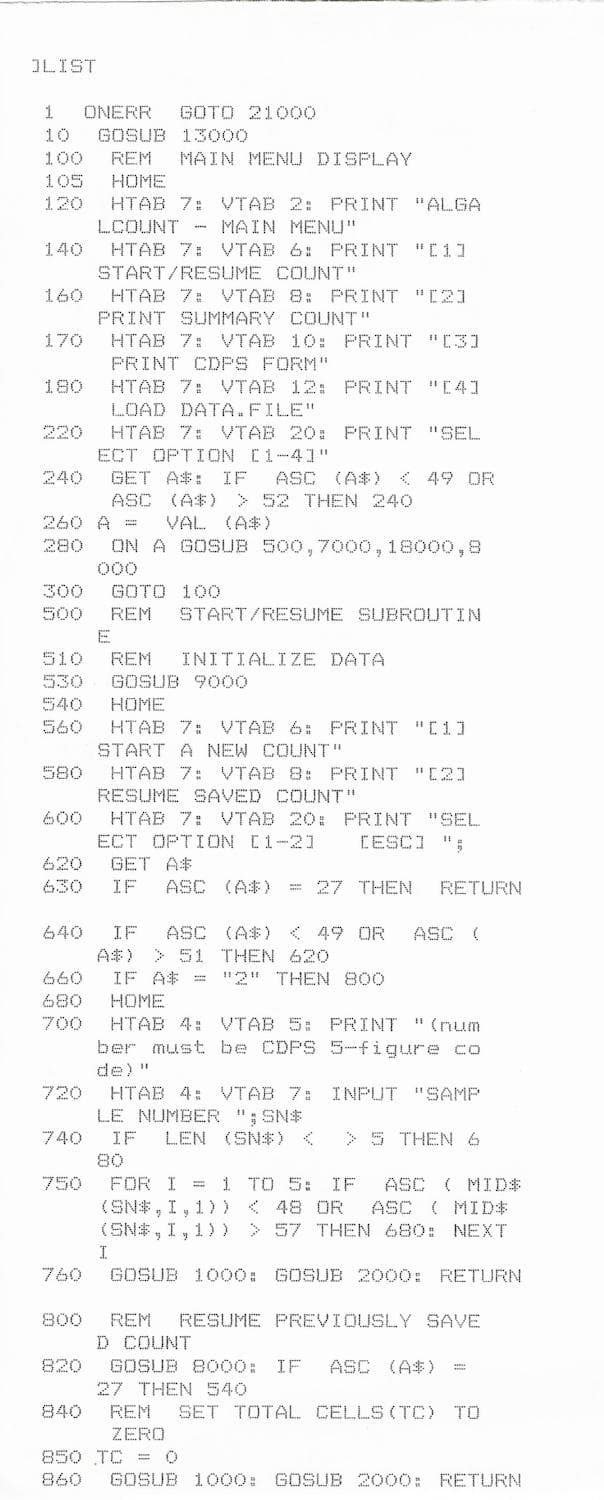
Algal Count programme listing (part)
Amstrad PCW 9512 (1990)
Also in 1990 I bought myself an Amstrad PCW 9512 from Robert Sayle (part of John Lewis) in Cambridge, which came complete with a daisy wheel printer. I used this mainly for word processing and a bit later purchased a Star Micronics LC-24-10 dot matrix printer. The photo below shows my setup in 1991, shortly after I'd bought my first house in Ely, Cambridgeshire. You can see the Star printer on the top of the desk, and the daisy wheel printer is on the lower shelf with my Brother electronic typewriter (on the right).
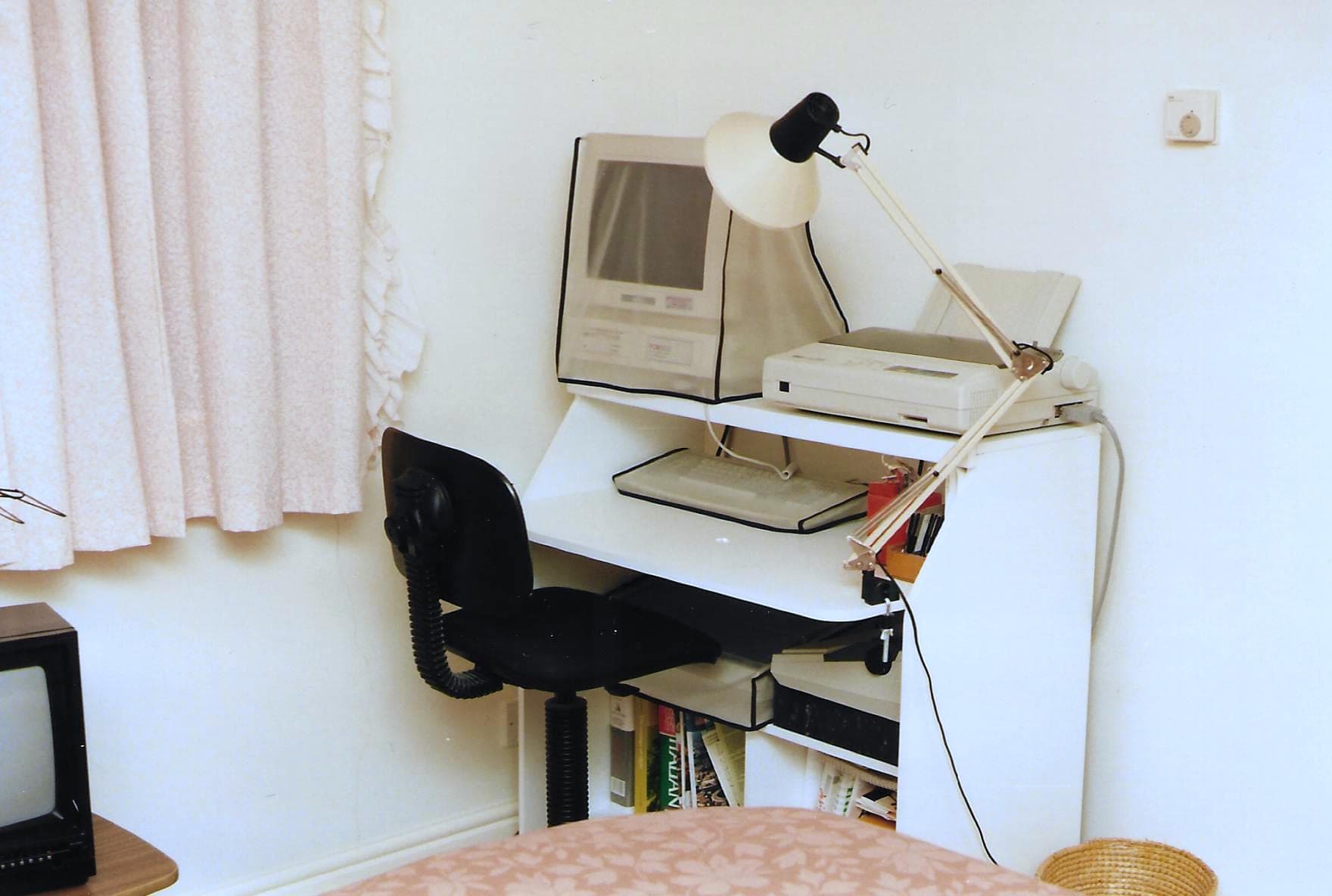
Amstrad PCW 9512 on my desk (1991)
The PCW 9512 was an 8-bit computer with a Z80 CPU. The system utilised bank switching to access its 512 KB of RAM, since the 8-bit Z80 CPU could only directly address 64 KB of memory at a time. The PCW 9512 had one 3-inch floppy disk drive and came bundled with the CP/M Plus operating system and the LocoScript word processor software.
Transition to IBM Compatibles (1994 -)
Some time in 1994, CompuServe UK began heavily marketing their online service. This was during the very early days of public Internet access in the UK, which had only become commercially available in 1992. CompuServe was a closed proprietary network that you had to dial into via a modem using their own infrastructure - not the same as the later dial-up connections to the Internet that became mainstream in the late 1990s. Users connected to CompuServe's private computers and services rather than the broader Internet.
It was at this time that I started getting mailshots from CompuServe including a guide to their services and a CD containing their Windows-based software to connect to and use their services. This immediately attracted me, offering email, forums, chat rooms, online shopping, and other features.
This was the big nudge I needed to finally switch to IBM compatible computers with DOS/Windows and the start of years of very big telephone bills! I sold my PCW 9512 to Cash Converters on Mill Road, Cambridge and bought a Compaq Presario 425 from Robert Sayle. This model featured an all-in-one design, with a built-in 14-inch monitor and a 486 processor. It included an integrated 2400 baud modem that the sales assistant assured me would be adequate for connecting to CompuServe. I soon realised it wasn't really fast enough, and upgraded to an external 14,400 baud modem, which made a dramatic difference to my CompuServe experience.
At this time I was still working at Anglian Water, but now as a Regulation Planner and based at their Histon Offices. I became increasingly interested in pursuing a career in computing. Along with a friend I even attended a presentation by Gateway Computers, who were expanding beyond their established direct mail-order business to roll out a new home-visit sales model. Their agents would visit people's houses to explain what was available and, after purchase, would come and set up the computer and explain how it works. Neither of us were convinced this was the opportunity we wanted, and Gateway ultimately struggled with their retail ventures in the years that followed.
Later a reorganisation at Anglian Water (one of many - it seemed to be a regular occurrence) presented the opportunity to take redundancy with a fairly decent pay-out. I thought about doing a conversion master's in Computer Science and had an interview at the University of Kent in Canterbury. Ultimately I decided against that, primarily because of the logistics of having to rent out my house for a year and move down to Canterbury. Instead, I chose to do an intensive three-month systems administration course with GP Learning Technologies in London, which I could easily commute to by train. This System Technology Accelerated Training Programme (START) was aimed at reskilling people for careers in the IT industry and led to a Microsoft Certified Systems Engineer (MCSE) qualification, a valued credential during this period. This proved a good decision as in January 2000, just a few weeks after finishing the course during the height of the dot-com boom, I started work as a Chief Computing Technician responsible for all aspects of the day-to-day running of the University of Cambridge Geography Department's IT service. I went on to stay at Cambridge for around 11 years, in various roles.
ZX Spectrum Next (2024 -)
In 2024 I started getting nostalgic for the old 8-bit computers of my youth. I bought a replacement ZX81 off eBay with the composite video mod so I could use it with a modern TV/monitor instead of the original RF output, a common and practical modification for using these vintage machines today. I also purchased a ZXPAND+, a modern expansion card that adds functionality like an SD card reader for instant file loading, 32K of RAM, an Atari-style joystick port, and built-in AY sound chip support.
In 2025 I became aware of the Spectrum Next project. The Spectrum Next is implemented using an FPGA (Field Programmable Gate Array), a reconfigurable chip that can be programmed to replicate the original Spectrum's hardware at the circuit level. This means it's running genuine hardware logic rather than software emulation - unlike products such as "The Spectrum" which emulate the machine in software - while also allowing enhanced features and complete backward compatibility with the original Spectrum. As I'd missed out on the various Kickstarter campaigns, I bought one of the Next clones - the N-GO from Manuferhi in Spain, which has a lovely mechanical keyboard.
My plans are to get back into programming in BASIC and to also learn Z80 assembly language. I was well aware of assembly back in the 1980s, but I think it scared me and I don't even recall ever trying to make a start with it - while my university courses taught BASIC and FORTRAN, assembly language was never covered and would have required a significantly different level of technical knowledge. The Z80 is actually an ideal platform for learning assembly today - it's manageable for a single person to master, unlike modern x86 assembly which is vastly more complex. Similarly, creating a complete game on these 8-bit systems is achievable solo, whereas modern game development typically requires teams with multiple specialised skills. So I'm determined to correct that missed opportunity from the 1980s. I'd like to write a game with graphics and I'll see how far I get. This blog will be about that journey!
Credits
License Notice:
The computer montage in this post is a derivative work by Marcus Young and is licensed under CC BY-NC-SA 4.0.
The Sinclair ZX81, a hobbyist home computer released in the UK in 1981." by Evan-Amos, used under CC BY-SA 3.0 / incorporated into photo montage
Commodore 16 home computer" by Ubcule, used under CC BY-SA 3.0 / incorporated into photo montage
An Apple IIe with two disk drives and a joystick attached running ProDOS." by Felix Winkelnkemper, used under CC BY-SA 4.0 / background removed, monitor screen blurred and incorporated into photo montage
Amstrad PCW 9512 microcomputer, 1987" by Science Museum Group Collection, used under CC BY-NC-SA 4.0 / background removed and incorporated into photo montage